
With his strategy to “weaken” Russia, the Joe Biden and Zelenesky may be turning the Ukraine war into a global one.
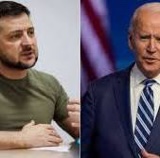
U.S. President Joe Biden and his NATO allies have escalated their policy of helping to defend Ukraine against Russian aggression into a policy of undermining the power and influence of Russia itself. In so doing, some observers fear, they are leaving Russian President Vladimir Putin little choice but to surrender or double down militarily, raising the possibility of widening his war beyond Ukraine.
The new U.S. and NATO strategy is partly based on Ukraine’s continuing battlefield success against Putin, who has been forced to scale down his ambitions from a full takeover of Ukraine to a major new assault in its eastern and southern parts. NATO allies including Germany, which until this week had equivocated on sending heavy offensive weaponry to Ukraine, have ratcheted up their aid in response. German Chancellor Olaf Scholz, under political pressure at home and abroad, announced earlier this week that his country would provide 50 anti-aircraft tanks to Ukraine.
Yet other Russia experts expressed worry that the United States and its Western allies are, in effect, crossing the very redlines they have avoided until now. For most of the two-month conflict, Biden has refused to authorize any military support, such as major offensive weapons or a no-fly zone, that might be perceived as putting U.S. or NATO forces in direct conflict with Russia. Now, some observers worry that with the additional aid and tougher economic sanctions, the U.S. president is forcing Putin into a corner in which he can only fight on or surrender. The latter course would mean relinquishing Putin’s career-long aim of strengthening Russia against the West. Yet Putin, who has long said the West’s goal was to weaken or contain Russia, has never been known to surrender during his decade and a half of aggressive moves against neighboring countries, mainly Ukraine and Georgia.
“In the Kremlin’s eyes the West is out to get Russia. It was unspoken before. Now it’s spoken,” said Sean Monaghan, an expert on Europe at the Center for Strategic and International Studies. “If you combine this with Biden’s comments, at his summit in Poland last month, that ‘this man [Putin] cannot remain in power,’ all that turns this a territorial war into a wider confrontation and might make negotiating a settlement to end the war in Ukraine far more difficult or even impossible at the present.” (Biden officials later said that the president was not seeking regime change in Russia.)
George Beebe, a former chief of Russia analysis for the CIA, said that the Biden administration may be in danger of forgetting that the “the most important national interest that the United States has is avoiding a nuclear conflict with Russia.” He added that “the Russians have the ability to make sure everyone else loses if they lose too. And that may be where we’re heading. It’s a dangerous corner to turn.”
 ThEagle News